Gaming and education, tested against the nom drills, KidLisp cards, and the oskiewar coach · 6pp
Eat the Right Answer reads three objects built inside Aesthetic.Computer against the games-and-learning literature: the nom family of muncher drills, whose June paper's prediction is tested against three months of commits; KidLisp cards, a program on a card handed to a UCLA cohort; and the oskiewar coach, a spectator process that never presses a button and keeps a ledger for a model. All three share a seam: a fixed engine, a swappable table, and a watcher on the outside. The drill has no watcher. That is the next table to write.
Stallman's licensing map and where Aesthetic.Computer stands · 6pp
Free Versus Nonfree reconstructs Stallman's map of software licensing from his 1998 essay and its 2007 rewrite: one ethical line drawn by four freedoms, copyleft versus lax inside it, commerce as a separate axis. It then applies the map to this repository and finds it source-available, not yet free.
What is publicly recoverable about ProPublica: origin, nonprofit structure, newsroom and partner network, data tools, people, money, reach, awards, corrections, and disputed work. Fact-surfacing, not argument.
Paths, Equivalence, and Evidence in a Tiny Creative Language · arXiv 7pp
Equal Enough to Draw studies what homotopy type theory can honestly contribute to KidLisp without pretending the live language is a proof assistant. It separates source, AST, render, trace, contextual, and type-level identity; defines bounded observational equivalence over a host, input trace, frame horizon, and tolerance; and proposes content-addressed path certificates beside the permissive paint loop.
An essay on API-made vinyl and cassette fulfillment · podcast
A podcast asks to become an object. This essay maps two routes from an Aesthetic Computer episode to the mailbox: Kunaki's product-and-order API for one-off vinyl, and Tape On Demand's more human cassette workflow. It argues for a shared physical-release manifest, a deliberate payment gate, and a side B that can turn physical media into correspondence.
A Nine-Vector Platform Report · arXiv-style · Summer 2026
Stack of the Summer '26 cuts through Aesthetic Computer's living platform: the piece lifecycle and creative runtime, user data and backend choices, realtime and deployment, KidLisp publishing, shared services, desktop and bare-metal embodiments, engineering quality, privacy boundaries, and architectural history. It distinguishes canonical, transitional, and experimental layers, then names the priorities that can thicken the platform without losing its narrow creative waist.
A turntable lets a listener hold recorded sound directly, while streaming apps reduce playback to a menu of approved speeds. This essay asks why production tools remain instruments while consumer players became transport controls, and argues for audible, continuous scrubbing that gives the recording back to the hand.
Expressive Control and the Impoverishment of Consumer Playback · arXiv 10pp
A record scratch gives you continuous, gestural, real-time control over a recording; YouTube and Spotify give you a dropdown of round speeds, and some give nothing at all. This paper names that gap 'granularity,' grounds it in the theory of directness and the mature craft of turntablism and elastic audio, and shows that Aesthetic Computer already ships the alternative across its players. The real opening is not that the instrument is impossible, but that it lives everywhere except the default transport of the apps you actually listen and watch through.
A mid-month postcard from July 10th --- not the monthly essay but a check-in written because someone asked how it was going. The answer: living in two times at once. Told as three scenes: excavating Whistlegraph, an artform made years ago with a friend, now counted (963 videos transcribed, 424 songs clustered, ~1.72 billion views) and given a hand-lettered legal-pad home at whistlegraph.org; a brand-new fighting game, fight, born in two days with its rollback safety net built before its network floor; and Menuband bounced from App Store review for naming macOS in its subtitle, then let through after learning to say one word less. Also available as a spoken reading in @jeffrey's voice.
An overview deck of the Aesthetic Computer and whistlegraph media estate: twelve accounts across nine surfaces, which can be posted to by script today, and the build-out plan. The whistlegraph archive still moves tens of thousands of views a day; the deck argues the work is connecting that audience to the new instrument, starting with Instagram.
An Independence Day special between the June and July essays, written on the Declaration's 250th anniversary. Independence is a hanging word --- in + dependere, not to hang from --- and the essay follows it in the abstract: declarations versus definitions in C and in Philadelphia, the personal computer as an independence movement the cloud quietly reversed, artists who built their own rooms (a library in a church, folk songs as open-source software, an artwork designed to scan badly), and an honest ledger of which way one small platform hangs --- a podcast hung from a host, Menuband submitted to App Store review on the holiday weekend itself, and the CNAME record as infrastructure's most truthful sentence.
Aesthetic June '26 is the storytelling companion to May. Where May was the modal mood, June is the answer, delivered as four hundred and fifty-seven commits --- the word carrying both its meanings, version control and Juno's oath. Told as scenes: the songs that caught up, the whistle found a perfect fifth sharp, the ring of native wizards learning one sign-in, and a Danish learn-the-clock community getting its own front door on the chat. Also available as a spoken reading in @jeffrey's voice.
A plain-spoken companion to Keymaps as Social Software · essay
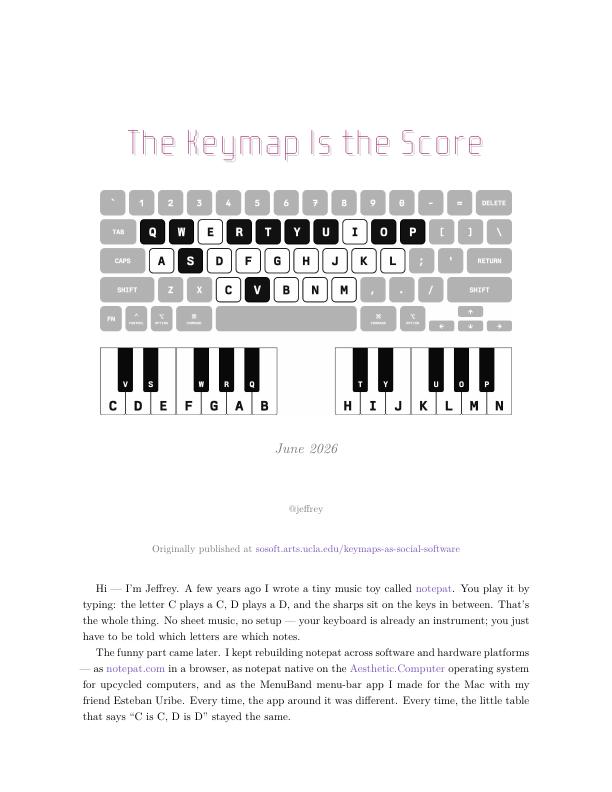
A keymap is more than a hidden preference table: it is an agreement that travels between people, programs, and machines. This essay names the inherited AWSED piano layout, introduces notepat's notes-that-name-themselves alternative, and follows that argument into the hand-assembled Scores for Social Software edition at UCLA.
A URL-Addressable Calendar for Aesthetic Computer · arXiv 6pp
AesthetiCal adds time to Aesthetic Computer as a piece, not a second app: month/week/day views and a DateWizard share a per-handle synced store, addressable by permahandle and interchangeable as standard iCalendar. The paper describes the shipped v1 and sketches the next phase — bookable shows, invites, and the Aestheticks ticketing tie-in.
Three Eras of My Own Code: Hand-Written, GPT-Grafted, Agentic · arXiv 4pp
The Hand and the Loop reads AC's git history across three eras — hand-written, GPT-grafted, and fully agentic — and asks honestly whether the codebase is better off. It weighs 5x velocity and five new subsystems against the loss of instrument-like minimalism, and argues for keeping the loop in the leaves while a human hand carves the foundational libraries.
The nom games rebuild MECC's Word and Number Munchers as Aesthetic Computer pieces --- numbnom, engnom, mexinom, and notenom. The paper shows how one shared engine and a reusable virtual synth controller turn each new subject or language into a content table rather than a new game, with the answer key in notenom doubling as a playable instrument.
Aesthetic May '26 is a magazine-style essay companion to Five Years from Now. May is both the month and the modal verb of possibility; the essay reads the present as a field of branching maybes rather than a line of probabilities --- where the music lane may go, what jeffrey may do, what may not happen this year, and the weather acting on all of it. First entry in the essay-* lane.
501(c)(3) artist-grant funder · 990 + grantee record · arXiv
What is publicly recoverable about Creative Capital, the New York nonprofit (1999–) that regrants to individual artists: structure, the award, people, and money from the IRS 990 series and the public grantee record. Scaffold revision — figures pending; fact-surfacing, not argument.
What is publicly recoverable about Creative Time, the New York public-art nonprofit (1974–): structure, programs, people, and money from the IRS 990 series and its program archive. Scaffold revision — figures pending the data pass; fact-surfacing, not argument.
What's New CalArts!? surfaces what is publicly recoverable about CalArts in a news-format dossier: programs, finances, and governance from public documents. The dossier records the record and stops at the facts.
The public-company flip · SEC EDGAR + 11-year archive · arXiv
The public-company side: what is publicly recoverable about MicroVision (NASDAQ: MVIS) from SEC EDGAR and an eleven-year family archive of filings. Fact-surfacing, not argument.
What is publicly recoverable about Eyebeam: financials, governance, residencies, and named grants pulled from IRS 990 XML. The dossier surfaces the record without interpreting it.
What is publicly recoverable about HathiTrust: a University of Michigan library service with no separate IRS 990, surfaced instead through host-institution disclosures and public reports. Fact-surfacing, not argument.
What is publicly recoverable about Heavy Manners Library: a small space whose legal status is undisclosed, surfaced through what little public record exists. The dossier records the gaps as part of the record.
What is publicly recoverable about the Internet Archive: finances and governance from IRS 990 filings, plus a litigation track from public court records. The dossier records both and stops at the facts.
501(c)(3) recipient (until 2018) · Echo Park · arXiv
What is publicly recoverable about Machine Project: the Echo Park space's finances and governance from IRS 990 filings through its 2018 wind-down. Fact-surfacing, not argument.
The funder flip · 990-PF + grants database · arXiv
The funder side: what is publicly recoverable about the Mellon Foundation from its 990-PF and grants database — the Form 990-PF that paid for nontrivial chunks of the other dossiers. Fact-surfacing, not argument.
What is publicly recoverable about NEW INC, the New Museum's incubator: finances and governance read out of the parent museum's IRS 990, where the program is embedded rather than separately filed. Fact-surfacing, not argument.
What is publicly recoverable about Pioneer Works: finances, governance, and a founder-as-funder structure reconstructed from IRS 990 filings and public record. The dossier surfaces the record without interpreting it.
Recurse Center · for-profit, recruiting-funded model · arXiv
What is publicly recoverable about the Recurse Center: a for-profit programmers' retreat funded by a recruiting model, read through founder interviews and public statements. Fact-surfacing, not argument.
What is publicly recoverable about Rhizome.org: governance, finances, and named grants reconstructed from IRS 990 filings and masthead snapshots. The dossier records the documentary record and stops where the facts run out.
School for Poetic Computation · LLC, public finance repo · arXiv
What is publicly recoverable about the School for Poetic Computation: an LLC that publishes its own finances to a public GitHub repository, read alongside programs and people. Fact-surfacing, not argument.
What is publicly recoverable about the Studio Museum in Harlem: finances, governance, and a capital campaign reconstructed from IRS 990 filings and public documents. The dossier records the documentary record.
What is publicly recoverable about The Kitchen: a half-century of finances and governance reconstructed from IRS 990 filings and public record across the organization's long arc. The dossier stops where the facts run out.
Addressable Creative Computing from Lovelace's Footnotes to Aesthetic Computer · arXiv
The URL Tradition traces address-thinking from Lovelace's footnotes, Bush's trails, Xanadu, and the Negro Motorist Green Book through net.art, single-serving sites, the tilde, Glitch, and Aesthetic Computer's prompt-as-address-bar. It argues the URL is not a feature but a medium property that reshapes authorship, distribution, pedagogy, performance, and political claim.
John Holden's Proto-Cognitive Music Theory and Aesthetic Computer · arXiv 7pp
The Potter and the Prompt argues that AC independently converges on the core principles of John Holden's 1770 proto-cognitive music theory. It proposes AC as a computational laboratory for advancing Holden's unfinished program on grouping, attention, and the module.
Funding, Burnout, and Survival in Open-Source Creative Computing · arXiv 5pp
A short look at who supports open-source creative tools and what that labor costs. The paper connects funding, burnout, and long-term maintenance to the life of artistic software.
Two Departments, One Building examines how funding and infrastructure shape creative work in shared spaces. The paper looks at administrative boundaries as part of the artistic system.
Handle Identity on the AT Protocol treats naming as a social and technical problem. The paper explores how handles, identity, and publishing can be tied together without losing portability.
CalArts, Callouts, and Papers turns a local institutional context into a study of friction, attention, and production. The paper leans into psycho style to show how academic labor is staged and performed.
Five Years from Now is a projection paper about where the project could go if current habits continue. It uses the near future to test the consequences of today's decisions.
Get Closed Source Out of Schools makes the case that creative computing should be teachable, inspectable, and modifiable. The paper argues for open tools as infrastructure for learning.
Reading the Score looks at the graphic score as an interface for interpretation and collaboration. The paper treats notation as a computational and social object.
Laptop Orchestras, PLOrk Heritage, and Aesthetic Computer · arXiv
This paper connects Aesthetic Computer to laptop orchestras and the collaborative traditions of PLOrk. It treats the browser as a place for ensemble practice, not just solo desktop programming.
Platform Hegemony, Critique-as-Content, and Anti-Environments · arXiv 5pp
Sucking on the Complex critiques platform hegemony and the way critique becomes content. It looks for anti-environments that stay messy, resistant, and alive.
Processing at the Core of the Piece API · arXiv 7pp
The Piece API rethinks creative software around composable pieces instead of monolithic apps. It uses Processing's lineage to connect setup(), boot(), and the act of publishing.
A Minimal Lisp for Generative Art with Social Composition · ELS ACM SIGS 4pp
An ELS conference version of KidLisp that emphasizes social composition. It positions the language as a shared practice rather than a solo scripting environment.
No submission receipt in mail (checked 2026-10-15).
Diversity and Inclusion in AC Paper Citations · 4pp
Citation Diversity Audit looks at who gets cited in the papers and where the archive is thin. The paper uses citation patterns as a proxy for inclusion and intellectual range.
Goodiepalian Approaches in Aesthetic Computer · arXiv 5pp
This paper treats Goodiepalian practice as a model for radical computer art. It emphasizes play, notation, and the social life of systems over polished product design.
Dormant Paths, Evolutionary Branches, and Abandoned Approaches · arXiv 4pp
The paper catalogs dormant branches, abandoned experiments, and paths that never became default. It treats dead ends as useful history rather than failure.
Drawing, Singing, and the Graphic Score as Viral Form · arXiv 4pp
Whistlegraph explores drawing, singing, and score-making as forms that can spread like software. The paper links graphic notation to performance, remix, and browser-native sharing.
A Bare-Metal Creative Computing Operating System · arXiv 5pp
AC Native OS describes a bare-metal runtime for creative computing. It focuses on boot-time simplicity and the idea that the operating system itself can be a programmable art surface.
Tracing the Evolution of AC Through Its Git History · arXiv 3pp · interactive timeline
Repository Archaeology traces the project through its git history. The paper shows how version control can become a narrative medium for design evolution.
From Keyboard Toy to System Front Door · arXiv 5pp
notepat.com is framed as a keyboard-first front door to the system. The paper follows the toy-like input surface as it grows into a fuller creative interface.
The Piece as a Unit of Creative Cognition · arXiv 4pp
A piece is treated here as the basic unit of creative cognition in AC. The paper argues that smaller, shareable pieces encourage composition, remix, and publication.
A Mobile-First Runtime for Creative Computing · arXiv 5pp
Aesthetic Computer is presented as a mobile-first creative computing runtime where the interface, publishing flow, and community feedback loop are part of the medium. The paper argues that small pieces can make software feel more social, more portable, and easier to share.
Venue edition: papers/cc-demo-2026. No submission receipt in mail (checked 2026-10-15).
A Minimal Lisp for Generative Art on a Social Platform · arXiv 6pp
KidLisp is the platform's tiny Lisp for building visual and musical pieces in the browser. The paper shows how a minimal language can stay approachable while still supporting generative art and composition.
Venue edition: papers/iccc-kidlisp. No submission receipt in mail (checked 2026-10-15).